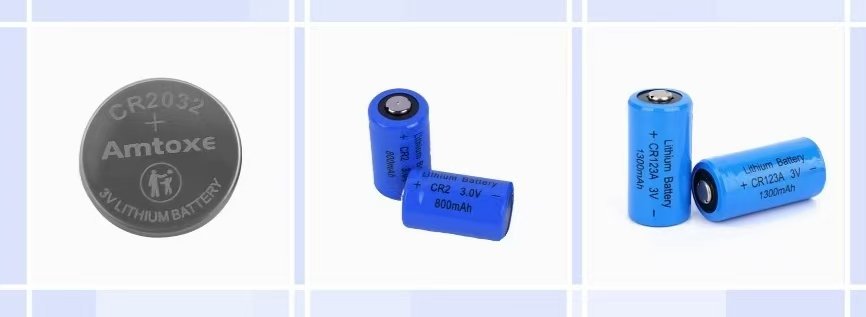
CR123A vs. CR2 vs. CR2032: Same Chemistry, Completely Different Beasts
If you’ve ever wondered what sets these three batteries apart, here’s the quick breakdown.
They all start with “CR,” share the exact same Lithium-Manganese Dioxide (Li-MnO2) chemistry, and have a nominal voltage of 3V. But don’t let the similarities fool you—their physical designs, internal structures, and discharge capabilities are worlds apart. They are absolutely NOT interchangeable.
Here is what you need to know:
1. Size Matters
- CR123A: A short, stout cylinder (~17mm x 34mm). Thicker and shorter than a standard AA.
- CR2: A slimmer, shorter cylinder (~15mm x 27mm) compared to the CR123A.
- CR2032: A flat, coin-shaped button cell (20mm diameter, 3.2mm thick).
2. Internal Structure & Discharge Power
- CR123A & CR2: Built with a jelly-roll (wound) structure. This maximizes electrode surface area and lowers internal resistance, allowing them to deliver high pulse currents for short bursts.
- CR2032: Built with a stacked coin-cell structure. Higher internal resistance makes it perfect for micro-current, long-standby applications, but it cannot handle high-current pulses.
3. Built for Different Jobs
- CR123A: High-power pulse devices like tactical flashlights, security alarms, camera flashes, and smart locks.
- CR2: Compact optoelectronics like laser rangefinders, rifle scopes, golf rangefinders, and vintage film cameras.
- CR2032: Low-power, long-standby devices like car key fobs, PC motherboard CMOS, digital scales, thermometers, and small remotes.
The Takeaway:
Same chemical recipe, but entirely different structural designs and discharge profiles. Always match the battery to the specific power demands of your device—high power, medium power, or micro-power. Never force a swap!